FHSA Contribution Deadline: Why 31 December Matters
Last updated:
This article is general information, not financial advice. Rates, limits and offers change, so confirm current details with the source or a licensed professional. Read the full disclaimer.
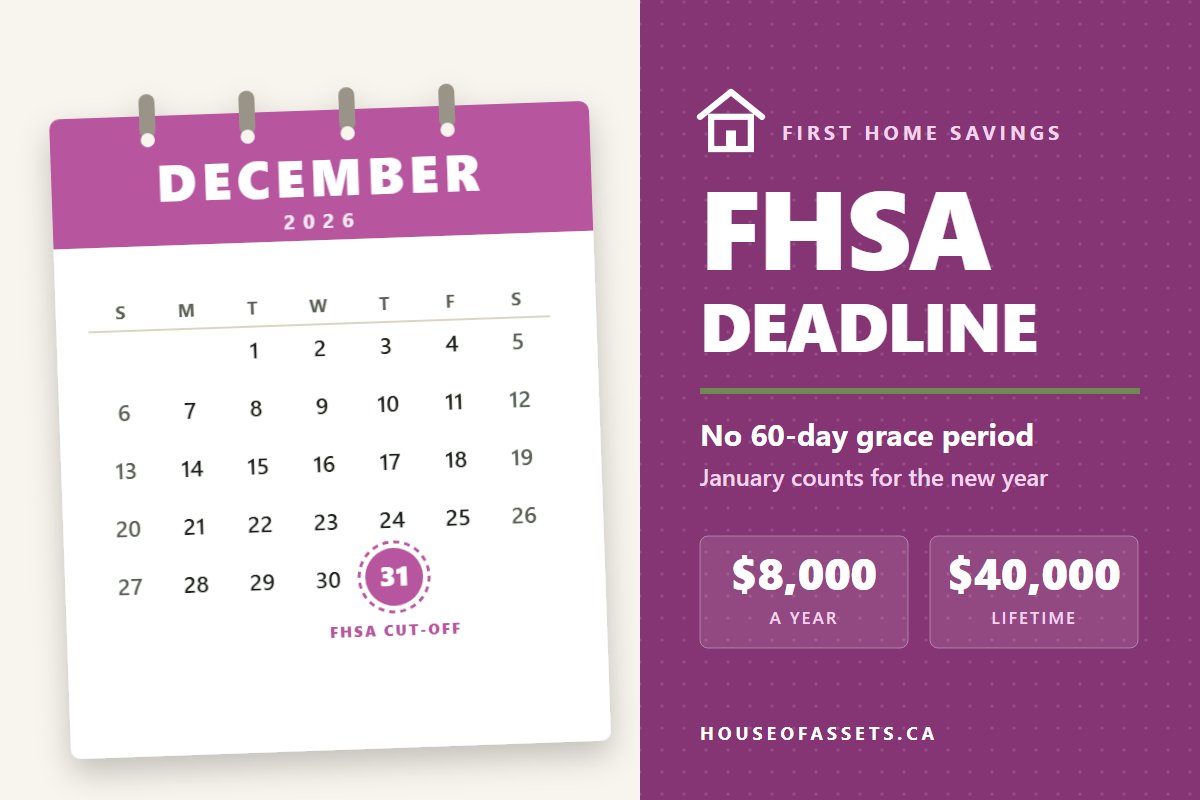
The deadline for First Home Savings Account (FHSA) contributions is 31 December, so money for the 2026 year has to be in the account by Thursday, 31 December 2026. Unlike an RRSP, the FHSA has no 60-day grace period: according to the Canada Revenue Agency (CRA), a contribution made in January or February counts for the new year and cannot be deducted on the previous year's return.
That one rule catches a lot of people who are used to RRSP season. This guide covers what has to happen by 31 December, what can wait, and how the yearly room and carry-forward work, with figures as of November 2026.
Quick answer
- Contribution deadline: 31 December of each year. The FHSA year runs from 1 January to 31 December.
- No 60-day rule: contributions made in the first 60 days of 2027 count toward 2027, not 2026.
- Yearly room: $8,000 in the year you open your first FHSA, with up to $8,000 of unused room carried into the next year.
- Lifetime limit: $40,000 in contributions and RRSP transfers combined.
- Opening date matters too: room only starts building once an FHSA is open, so opening an account by 31 December starts the clock for that year even with no money in it.
- The deduction can wait: money put in by 31 December can be deducted on that year's return or saved for a later year.
FHSA vs RRSP deadline side by side
| FHSA | RRSP | |
|---|---|---|
| Contribution year | 1 January to 31 December | Calendar year plus the first 60 days of the next year |
| Deadline for the 2026 tax year | 31 December 2026 | The first 60 days of 2027 |
| January or February contribution | Counts for the new year only | Can be deducted for the previous year |
| Yearly limit | $8,000, plus up to $8,000 carried forward | 18% of earned income up to a yearly maximum, less pension adjustments |
| Unused room | Up to $8,000 carries forward, and only after the account is open | All unused room carries forward |
| Lifetime limit | $40,000 | None |
Sources: CRA, Tax deductions for FHSA contributions, CRA, Participating in your FHSAs, CRA, Important dates for RRSPs.
What has to happen by 31 December
Three things are tied to the calendar year:
- Contributions. Anything you want counted toward 2026 room has to be contributed by 31 December 2026.
- Transfers from an RRSP. Moving money from an RRSP into an FHSA uses the same yearly room as a contribution, so a transfer meant for 2026 also has to be done in 2026.
- Opening the account. The year you open your first FHSA is the first year you get $8,000 of room. A year with no open FHSA gives no room and nothing to carry forward.
Banks and brokerages set their own cut-off times for year-end deposits and transfers, and 31 December 2026 falls just after the Christmas and Boxing Day closures. The date that counts is when the money lands in the FHSA, so it is worth checking your institution's cut-off well before the last week of the year.
Why opening an FHSA before year-end matters
FHSA room does not start building at age 18 the way TFSA room does. It starts the year your first FHSA is opened. CRA gives the example of someone who opened an FHSA in June 2026 and put nothing in. After filing the 2026 return, the statement showed $16,000 of room for 2027: the $8,000 for 2027 plus $8,000 carried forward from 2026.
| When the first FHSA is opened | Room in 2026 | Most room available in 2027 |
|---|---|---|
| Any day in 2026, up to 31 December | $8,000 | $16,000 if nothing was contributed in 2026 |
| 2 January 2027 or later | None | $8,000 |
The second row has no 2026 room to carry, so the most that can go in during 2027 is $8,000. An empty FHSA opened in December 2026 has no tax cost, but it still has to be reported (see the filing section below).
To open an FHSA, CRA says you must be a resident of Canada, at least 18 (19 in provinces where that is the age to sign a contract), no older than 71 at the end of the year you open it, and a first-time home buyer. For this purpose that means you did not live in a home that you or your current spouse or common-law partner owned as your main residence at any time in the current year or the four years before. Full conditions are on the CRA opening page.
How the yearly room and carry-forward work
Each year you get $8,000 of new room. If you use less, the unused part carries into the next year, but the carry-forward is capped at $8,000. So the most anyone can put in during a single year, before any special adjustments, is $16,000.
A worked example, using CRA's rules:
| Year | New room | Carried in | Room for the year | Contributed | Carried out |
|---|---|---|---|---|---|
| 2025 (account opened) | $8,000 | $0 | $8,000 | $3,000 | $5,000 |
| 2026 | $8,000 | $5,000 | $13,000 | $0 | $8,000 (capped) |
| 2027 | $8,000 | $8,000 | $16,000 |
In this example, $13,000 of room is available in 2026. If none of it is used by 31 December 2026, only $8,000 carries into 2027 because of the cap. The other $5,000 is not lost from the $40,000 lifetime limit, but it can no longer go in during 2027 on top of the $16,000. It takes longer to reach the $40,000 total, and the account only lasts 15 years.
Investment growth inside the FHSA does not use up room. CRA's example shows an account that grew from $8,000 to $8,600 with no over-contribution.
What if you put in too much?
Contributions and RRSP transfers above your room for the year create an "excess FHSA amount". CRA charges a tax of 1% per month on the highest excess in each month until it is removed, and you have to file Form RC728. The excess can be taken out or moved to an RRSP using Form RC727.
The two most common ways people end up over the limit are:
- Assuming each FHSA at a different bank has its own $8,000. The room is shared across all of your FHSAs.
- Counting an RRSP transfer separately from contributions. CRA's examples show they share one limit: a $7,500 RRSP transfer plus a $500 contribution uses the full $8,000.
More detail is on the CRA page on over-contributing.
The contribution deadline is not the deduction deadline
Contributing by 31 December and claiming the deduction are two separate steps. According to CRA, FHSA contributions can be deducted in the year they are made or carried forward to a future year, even after the FHSA is closed. Some people hold the deduction for a year when their income, and so their tax rate, is higher.
Some amounts can never be deducted:
| Deductible | Not deductible |
|---|---|
| Contributions made from 1 January to 31 December, within your room | Transfers from an RRSP to an FHSA |
| Unused contributions from earlier years, carried forward | Contributions made after your first qualifying withdrawal for a home |
| Investment losses, fees, and interest on money borrowed to contribute | |
| Amounts above the $40,000 lifetime limit |
Filing after you open an FHSA
You must fill out Schedule 15 with your tax return for the year you open your first FHSA, even if you put nothing in. That is how CRA learns the account exists and starts tracking your room. Your FHSA issuer sends a T4FHSA slip showing contributions and transfers. After your return is assessed, your FHSA room for the next year appears on your notice of assessment and in your CRA account under "Savings and pension plans".
Other FHSA dates to know
| Rule | Date |
|---|---|
| Contribution year | 1 January to 31 December |
| End of the account's life | 31 December of the year of the earliest of: the 15th anniversary of opening your first FHSA, the year you turn 71, or the year after your first qualifying withdrawal |
| Qualifying withdrawal for a home | You need a written agreement to buy or build a home, with the purchase or completion date before 1 October of the year after the withdrawal |
| Tax on an excess amount | Form RC728 is filed and the tax paid by 30 June of the following year |
Anything left in an FHSA when its life ends is added to your income for that year unless it was moved to an RRSP or RRIF first, according to the CRA page on closing an FHSA.
FAQ
Can I contribute to my FHSA in January and claim it on last year's taxes?
No. CRA says FHSA contributions made in the first 60 days of a year cannot be deducted on the previous year's return. A January 2027 contribution can be deducted on the 2027 return or a later one.
Do I lose my FHSA room if I miss 31 December?
You lose some of it if more than $8,000 is unused, because only $8,000 carries forward to the next year. Room that does carry forward can be used in the next year on top of the new $8,000.
Is it worth opening an FHSA in December with no money in it?
That depends on your plans, but the effect is clear: an FHSA opened by 31 December 2026 gives $8,000 of 2026 room, which can carry into 2027 and allow up to $16,000 that year. The account also starts its 15-year clock on the day it opens.
Does my RRSP-to-FHSA transfer have the same 31 December deadline?
Yes. Transfers from an RRSP count toward the same yearly FHSA room as contributions, so a transfer has to be completed by 31 December to count for that year. Transfers are not deductible.
Do I have to deduct my FHSA contribution in the same year?
No. You can claim it in the year you contribute or carry it forward to any later year, even after the account is closed.
Related reading on House Of Assets
- GIC vs High-Interest Savings Account for an Emergency Fund (GICs and savings deposits can also be held inside an FHSA)
- Emergency Fund: Suggestion On How To Structure One
- Canada's Budget 2026: Who Benefits and What It Means for Your Money (the housing measures for buyers)
Sources
- CRA: Participating in your FHSAs
- CRA: Tax deductions for FHSA contributions
- CRA: Opening your FHSAs
- CRA: Closing your FHSAs
- CRA: What happens if you contribute or transfer too much to your FHSAs
- CRA: FHSA taxes payable, assessments and reassessments
- CRA: Schedule 15, FHSA Contributions, Transfers and Activities
- CRA: Important dates for RRSPs
Last updated: 6 November 2026.