GIC vs High-Interest Savings Account for an Emergency Fund
Last updated:
This article is general information, not financial advice. Rates, limits and offers change, so confirm current details with the source or a licensed professional. Read the full disclaimer.
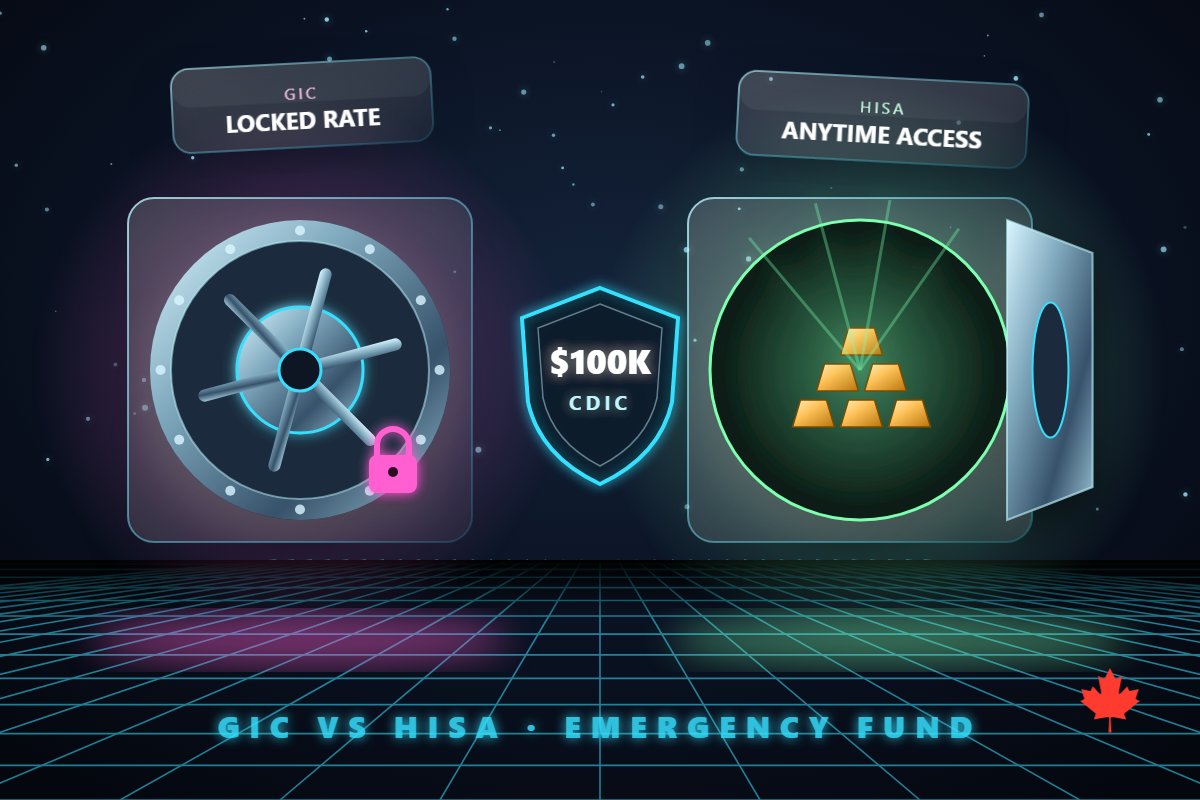
The main difference between a GIC and a high-interest savings account (HISA) for an emergency fund is access: a HISA lets you take money out any day, while most GICs lock your money in until the term ends in exchange for a set rate. Both can be covered by CDIC deposit insurance up to $100,000 per category at each member institution, and in both cases the interest is taxed as income unless the account sits inside a TFSA or another registered plan.
An emergency fund exists to be there on a bad day: a layoff, a leaking water heater, a tenant who stops paying. So the question is less "which pays more" and more "how fast can I reach it, and what does it cost me to get it out early." This guide sets the two side by side so you can see how each one behaves.
Quick answer
- HISA: money is available whenever you need it, the rate can change at any time, and introductory rates often drop after a few months.
- Non-redeemable GIC: the rate is fixed for the term, but you generally cannot take the money out before it matures.
- Cashable or redeemable GIC: you can cash it early, usually for a lower rate than a locked GIC, and some pay little or no interest if cashed in the first weeks or months.
- Both can be CDIC-insured when held at a CDIC member, up to $100,000 per insured category per institution. HISA ETFs and money market funds are not CDIC-insured.
GIC vs HISA side by side
| Feature | High-interest savings account | Non-redeemable GIC | Cashable or redeemable GIC |
|---|---|---|---|
| Access to money | Any time, often same day by transfer | Usually not until the term ends | Before maturity, under the GIC's terms |
| Interest rate | Variable, can change at any time | Fixed for the term | Fixed, usually lower than a locked GIC |
| Typical terms | No term | 30 days to 5 years or more | Often 1 year or less |
| Cost of early access | None (watch for transaction fees) | Generally not allowed | Lower or no interest, depending on timing |
| CDIC coverage | Yes, if held at a CDIC member in an insured category | Yes, if issued by a CDIC member | Yes, if issued by a CDIC member |
| Tax on interest (outside a TFSA) | Taxed each year, reported on a T5 | Taxed each year as it is earned, even before you receive it | Same as other GICs |
Sources: CDIC, FCAC on GICs, FCAC on savings accounts, CRA line 12100.
How a high-interest savings account works
A HISA is a savings account that pays a higher rate than a regular savings account without locking your money in for a term. Interest is usually calculated daily and paid monthly, according to the Financial Consumer Agency of Canada (FCAC).
Three points matter most for an emergency fund:
- The rate is not fixed. It can move up or down whenever the bank changes it, often following the Bank of Canada.
- Introductory rates end. FCAC notes that many high rates are promotional and last a limited time. Check what the account pays once the promotion is over.
- Watch the fine print. Some accounts need a minimum balance before they pay interest, and some charge for withdrawals or transfers past a set number each month.
How a GIC works
A Guaranteed Investment Certificate (GIC) is a deposit you leave with a bank or other institution for a set term. In return you get your principal back at the end, plus interest at a rate set when you buy it. CDIC describes buying a GIC as lending money to the issuer.
GICs come in three broad types:
| GIC type | Can you cash it early? | What it usually means for the rate |
|---|---|---|
| Non-redeemable (locked) | Generally no | Highest rate of the three for the same term |
| Cashable | Yes, often after a short waiting period | Lower rate; cashing very early may earn little or no interest |
| Redeemable | Yes, with a penalty or reduced rate | In between, depending on the issuer's terms |
Before you buy, a federally regulated institution must tell you whether you can cash the GIC early and how doing so changes the interest you earn, according to FCAC. It must also tell you whether CDIC insures the product.
Watch for automatic renewal
Many GICs renew automatically at maturity, often into the same term at whatever rate applies that day. For a bank, FCAC says you get a notice 21 days and again 5 days before a term longer than 30 days ends, and you can cancel an automatic renewal within 10 business days of the new term starting. If the money is meant for emergencies, an unplanned five-year renewal can catch you out.
Is my emergency fund protected by CDIC?
Yes, when it is held as an eligible deposit at a CDIC member. CDIC covers savings deposits, GICs and other term deposits, in Canadian or foreign currency, up to $100,000 per insured category at each member institution, including principal and interest. Categories include deposits in one name, joint deposits, and deposits held in a TFSA, RRSP, RRIF, RESP, RDSP or FHSA, and each category is covered separately.
| Covered by CDIC (at a member) | Not covered by CDIC |
|---|---|
| Savings and chequing deposits, including HISAs | HISA ETFs and money market ETFs |
| GICs and other term deposits | Mutual funds, including HISA mutual funds |
| Deposits in foreign currency | Stocks and bonds |
| Eligible deposits inside a TFSA, RRSP, FHSA and other plans | Cryptocurrencies, including stablecoins |
Two details trip people up:
- A HISA ETF is not a HISA. Cash management and money market ETFs bought through a brokerage can pay a similar rate, but CDIC states they are not covered. A HISA or GIC bought through a broker can be covered if the money is held at a CDIC member, so ask which institution issued it.
- Credit unions are different. Most provincially regulated credit unions are covered by their own provincial deposit insurer, not CDIC, and the limits vary by province.
How is the interest taxed?
Outside a registered account, interest from a HISA or a GIC is fully taxable income. You report it on line 12100 of your return, and your institution sends a T5 slip when the interest is $50 or more. You still have to report smaller amounts.
Multi-year GICs have one extra rule. CRA says you report the interest earned in each complete investment year, even if the GIC has not paid it out yet. A compound GIC bought in July is taxed on its first year of interest the following tax year, not at maturity.
Inside a TFSA, interest from either a HISA or a GIC is not taxed, and withdrawals are tax-free. The amount you withdraw is added back to your TFSA room on 1 January of the next year, not the same year, so putting it straight back in can cause an over-contribution. See CRA on TFSA withdrawals.
A worked example with $10,000
The rates below are made up to show how the comparison works. Real rates change often; check current rates with your own institution or the FCAC Account Comparison Tool.
| HISA at 2.25% | 1-year cashable GIC at 2.50% | 1-year non-redeemable GIC at 3.00% | |
|---|---|---|---|
| Interest over 12 months, if untouched | About $227 (paid monthly) | $250 | $300 |
| Need $3,000 in month 4 | Withdraw it the same day; the rest keeps earning | Cash it under the GIC's terms; check what interest you keep | Usually not possible until month 12 |
| Rate if the Bank of Canada changes its rate | Can change | Stays fixed | Stays fixed |
In this example, locking the money in earns about $73 more over a year than the HISA, before tax. The trade-off is that the locked GIC cannot be reached for a surprise bill. The comparison comes down to that dollar gap set against how likely you are to need the money early.
Common ways people split an emergency fund
There is no single right structure. These are setups people commonly use, shown for information only:
- All in a HISA. Simplest, fully liquid, and the rate floats.
- Split between a HISA and cashable GICs. A few months of expenses in a HISA for the first weeks of an emergency, with the rest in cashable GICs.
- A GIC ladder behind a cash buffer. One or two months in a HISA or chequing account, with the rest spread across GICs that mature at different times (for example every three months), so some money becomes available regularly.
- Inside a TFSA. Any of the above can be held in a TFSA so the interest is not taxed, keeping the TFSA re-contribution rule in mind.
HOA shares how one personal setup works, with two months in chequing and four months in short-term cashable products, in Emergency Fund: Suggestion On How To Structure One.
Where interest rates stand, as of November 2026
On 28 October 2026 the Bank of Canada raised its policy rate by 0.25 percentage points to 2.50%. The Bank's October 2026 Monetary Policy Report projects inflation to stay around 3% through much of 2027. HISA rates tend to move with the policy rate, while a GIC keeps the rate it had on the day you bought it. When savings rates sit below inflation, cash in either product loses some buying power over time.
FAQ
Can I lose money in a GIC or a HISA?
Not your principal, as long as the deposit is eligible and within the CDIC limit at a CDIC member. You can lose interest you expected, for example by cashing a GIC early, and inflation can reduce what the money buys.
Is a cashable GIC better than a HISA for an emergency fund?
It depends on the rates on offer and the GIC's terms. A cashable GIC locks in a rate but may pay little or nothing if cashed in its first weeks. A HISA pays a rate that can change but lets you withdraw any day.
Are GIC and HISA interest taxed the same way?
Both are taxed as ordinary interest income outside a registered account. The difference is timing: interest on a multi-year GIC is taxed each year as it is earned, even before it is paid to you.
Is a HISA ETF the same as a high-interest savings account?
No. A HISA ETF is an exchange-traded fund bought through a brokerage, and CDIC does not insure it. A HISA is a deposit account at a financial institution and can be CDIC-insured.
How much should an emergency fund hold?
Common guidance ranges from three to six months of essential expenses, and some people keep more. The right amount depends on job stability, dependants and other savings. The emergency fund article covers how Employment Insurance fits in.
Related reading on House Of Assets
- Emergency Fund: Suggestion On How To Structure One
- The Get Rich, SLOW Scheme
- 21 Bitcoin Basics (why money for emergencies is kept apart from volatile assets)
Sources
- CDIC: What's covered
- CDIC: High Interest Savings Accounts
- CDIC: Guaranteed Investment Certificates
- FCAC: Guaranteed investment certificates and term deposits, know your rights
- FCAC: Savings accounts
- CRA: Line 12100, Interest and other investment income
- CRA: Withdrawing from a TFSA
- Bank of Canada: Policy rate raised to 2.50% (28 October 2026)
Last updated: 5 November 2026.