21 Bitcoin Basics: A Beginner's Guide for Canadians
Last updated:
This article is general information, not financial advice. Rates, limits and offers change, so confirm current details with the source or a licensed professional. Read the full disclaimer.
Bitcoin has been around since January 2009, which makes it close to 18 years old. In that time it has gone from being worth a fraction of a cent to being held by large investment firms, pension funds and exchange-traded funds (ETFs) you can buy in a regular brokerage account. It is still volatile. Over the last three years its biggest falls were about 33% (March to August 2024), about 32% (January to April 2025) and about 52% (from its record of around US$126,000 in October 2025 to about US$60,000 in February 2026), and it can move 10% or more in a single day. Over the same three years it also more than tripled, from under US$40,000 in late 2023 to that October 2025 record. There is a lot of potential, but only put in an amount you are comfortable holding through big drops, and never money you need for rent, bills or your emergency fund.
Whether you are new to Bitcoin, thinking about buying your first bit, or just curious what the fuss is about, here are 21 basics to know first. If a word is new to you, our Bitcoin terms glossary explains it in plain English.
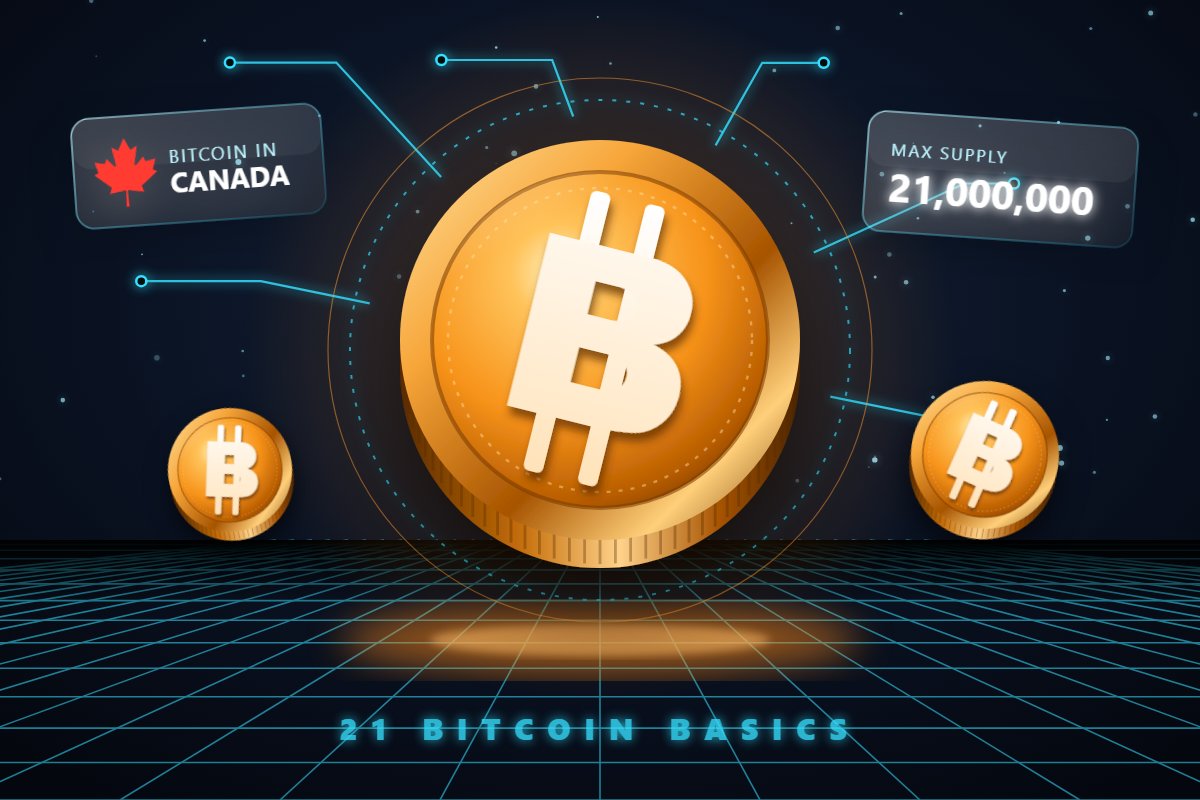
1. There will only ever be 21,000,000 (21 million) Bitcoin
- Unlike fiat currency like the US or Canadian dollar, which governments and central banks can create whenever they want (increasing the money supply and eroding what each dollar buys), Bitcoin has a hard cap of 21 million coins written into its code. Many holders see this fixed supply as the main reason Bitcoin can hold its value over time as more people want it, although the price still depends on demand.
2. More than 20 million Bitcoin have already been mined
- The 20 millionth Bitcoin was mined in March 2026, so over 95% of all Bitcoin already exists. The last fraction of a Bitcoin is not expected to be mined until around the year 2140.
3. Nobody knows who created Bitcoin
- Bitcoin was introduced by someone using the name Satoshi Nakamoto, who published the Bitcoin white paper on October 31, 2008. Satoshi stopped communicating publicly in 2011, and their real identity is still unknown.
4. The first Bitcoin block mined had a newspaper headline hidden inside it
- A block is a batch of Bitcoin transactions added to the record all at once, like one page in a shared record book. The very first block, mined on January 3, 2009, contains the headline "Chancellor on brink of second bailout for banks" from The Times of London. Many read it as a comment on the 2008 financial crisis and the bank bailouts that followed.
5. No company or government controls Bitcoin
- Bitcoin runs on thousands of computers (called nodes) around the world that all keep a copy of the same records and follow the same rules. There is no head office, no CEO and no single server to shut down, and the rules only change if the network broadly agrees.
6. You don't have to buy a whole Bitcoin
- Each Bitcoin can be split into 100 million smaller units called satoshis (or "sats"), named after its creator. You can buy $10 or $20 worth of Bitcoin just like you can buy a fraction of a share.
7. Every transaction is recorded on a public ledger called the blockchain
- Anyone can look up any Bitcoin transaction ever made using a free blockchain explorer. Wallet addresses are not tied to names, so Bitcoin is pseudonymous rather than anonymous: once an address is linked to a person, its history can be traced.
8. New Bitcoin are created through mining
- Miners use specialized computers to compete to add the next block of transactions to the blockchain, roughly every 10 minutes. The winner earns newly created Bitcoin plus the fees users paid, and this is how new coins enter circulation.
9. The mining reward is cut in half about every four years
- This event is called "the halving" and happens every 210,000 blocks. The most recent halving in April 2024 dropped the reward from 6.25 to 3.125 Bitcoin per block, and the next one is expected in 2028. Each halving slows the pace at which new Bitcoin are created.
10. Someone once paid 10,000 Bitcoin for two pizzas
- On May 22, 2010, a programmer named Laszlo Hanyecz paid 10,000 Bitcoin for two Papa John's pizzas, the first well-known purchase of a real item with Bitcoin. Bitcoin fans still celebrate May 22 as "Bitcoin Pizza Day."
11. The price swings a lot
- In earlier cycles Bitcoin fell more than 70% from its peak (in 2011, 2014, 2018 and 2022), and its most recent big fall was about 52% between October 2025 and February 2026. It has recovered from each fall so far, but past recoveries do not guarantee future ones. If a 50% drop would cause you to panic sell, the amount you hold is probably too large for your comfort level.
12. "Not your keys, not your coins"
- If you leave Bitcoin on an exchange, the exchange holds the keys and you are trusting it to give your Bitcoin back. Canadians learned this the hard way with QuadrigaCX, a Canadian exchange that collapsed in 2019. The Ontario Securities Commission found its clients lost at least $169 million. More recently, on October 29, 2026, hackers the FBI has linked to North Korea stole about US$6.3 billion from the hot wallets of Binance, the world's largest crypto exchange, in the largest crypto theft on record. Binance paused withdrawals, said it would cover the losses from its own funds, and reopened withdrawals on November 1. Events like these are one reason some people prefer a Bitcoin ETF, where a regulated fund company handles storage and there are no keys or seed phrases to manage, which they see as a safer option than holding their own coins.
13. Your seed phrase is the master key to your Bitcoin
- A self-custody wallet gives you a recovery phrase (a seed phrase) of 12 or 24 words. Anyone who has those words can take your Bitcoin, so write them down on paper (never in a photo, email or cloud note) and store them somewhere safe. No real company, exchange or support agent will ever ask for them.
14. Bitcoin transactions can't be reversed
- There is no bank to call and no chargeback. If you send Bitcoin to the wrong address or to a scammer, it is almost always gone for good, so double-check the address and consider sending a small test amount first.
15. Scammers love Bitcoin
- Watch out for "send 1, get 2 back" giveaways, romance scams, fake investment platforms, and anyone pressuring you to buy Bitcoin to pay a bill, a fine or the CRA (government agencies do not accept Bitcoin payments). If something seems off, you can report it to the Canadian Anti-Fraud Centre.
16. Millions of Bitcoin are probably lost forever
- Estimates suggest around 3 to 4 million Bitcoin have been lost through forgotten passwords, thrown-out hard drives and owners who passed away without sharing their keys. Those coins can never be spent, so the number of Bitcoin actually available is smaller than the supply figures suggest.
17. In Canada, you can buy Bitcoin through registered platforms or ETFs
- Canadians can buy Bitcoin on crypto trading platforms registered with Canadian securities regulators, or buy a Bitcoin ETF through a regular brokerage account. Canada was early here: the Purpose Bitcoin ETF, launched in February 2021, was one of the first Bitcoin ETFs in the world. In the US, BlackRock's iShares Bitcoin Trust (ticker IBIT) trades on the Nasdaq and is the largest Bitcoin ETF, with about US$67 billion in assets as of November 2026. BlackRock is the world's largest asset manager, with more than US$15 trillion under management. Most Canadian brokerages let you buy US-listed ETFs, but they trade in US dollars, so currency conversion costs apply. Before using a crypto platform, check that it is registered with the Canadian Securities Administrators.
18. Bitcoin ETFs can go in a TFSA, RRSP or FHSA
- Bitcoin held directly on a crypto platform can't be put inside a registered account, but Bitcoin ETFs listed on a Canadian exchange (and US-listed ones like IBIT) can be held in a TFSA, RRSP or FHSA, the same as other ETFs. ETFs charge an annual management fee, and you don't hold the keys yourself.
19. The CRA expects you to report Bitcoin gains
- The Canada Revenue Agency treats cryptocurrency as a commodity, not money. Selling Bitcoin, trading it for another crypto, or spending it can all trigger a capital gain or loss (or business income if you trade like a business), and under current rules half of a capital gain is taxable. Keep records of every purchase and sale, including dates and amounts in Canadian dollars.
20. Mining uses a lot of electricity
- Bitcoin's energy use is one of its biggest criticisms. Supporters point out that miners often use cheap surplus or renewable power (including hydro in places like Quebec) and that energy use is what secures the network.
21. Bitcoin is not the same as "crypto"
- There are thousands of other cryptocurrencies, and many have failed or turned out to be scams. Bitcoin was the first and is still by far the largest. If you picture the whole crypto market as a pie, Bitcoin makes up about 60% of it (Bitcoin dominance in late October 2026), Ether about 11%, stablecoins about 10%, and thousands of other coins share the remaining slice of roughly 19%. Be careful assuming that what is true for Bitcoin is true for every other coin.
How much Bitcoin do big finance firms suggest holding?
In the past couple of years, several of the world's largest investment firms have shared suggested ranges for Bitcoin or crypto as a small part of a diversified portfolio. BlackRock, the world's largest asset manager, said in December 2024 that 1% to 2% could be reasonable for investors who believe in its long-term adoption and can handle sharp drops. Fidelity Investments' research has suggested 2% to 5%, and up to 7.5% for younger investors with more time to recover from losses. In October 2025, Morgan Stanley's Global Investment Committee suggested up to 4% for its most growth-focused portfolios and 0% for portfolios focused on preserving capital or generating income. In December 2025, Bank of America said a 1% to 4% allocation to digital assets could be appropriate for investors comfortable with high volatility. These ranges come from US firms writing for their own clients' diversified portfolios, so treat them as a reference point rather than a recommendation for you. Your own amount depends on your goals, timeline and how well you sleep when the price drops.