Bitcoin Terms Explained: A Plain-English Glossary for Beginners
Last updated:
This article is general information, not financial advice. Rates, limits and offers change, so confirm current details with the source or a licensed professional. Read the full disclaimer.
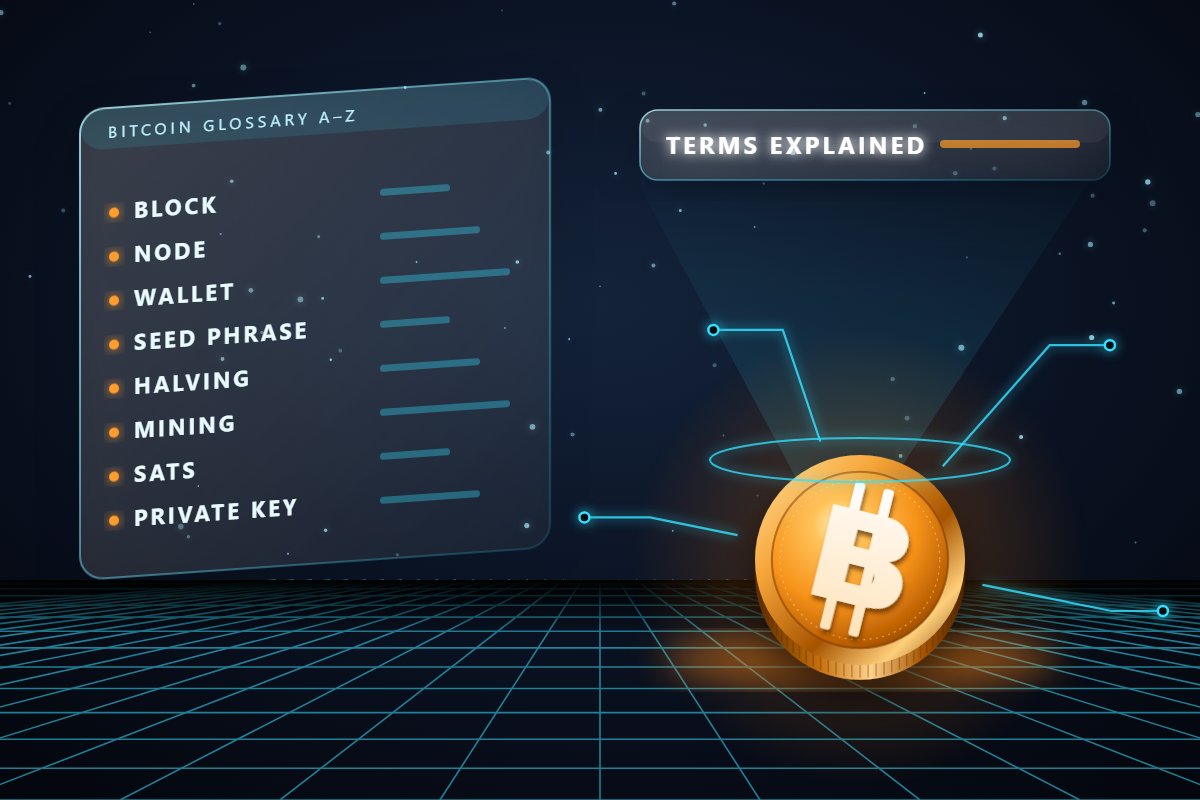
Bitcoin comes with a lot of new words. This glossary explains the common ones in plain English, in alphabetical order, so you can come back to it whenever a term in an article or an app doesn't make sense. If you're just getting started, our 21 Bitcoin Basics is a good place to begin.
Address
A string of letters and numbers that works like an email address for receiving Bitcoin. You can share your address with someone so they can send you Bitcoin, and it is safe to share because it can't be used to take anything out.
Altcoin
Any cryptocurrency other than Bitcoin. Ether, Solana and XRP are well-known examples, and there are thousands of others.
Bitcoin dominance
Bitcoin's market cap as a share of the whole crypto market. If dominance is 60%, then 60 cents of every dollar held in crypto is held in Bitcoin.
Bitcoin ETF
An exchange-traded fund that holds Bitcoin and trades on a stock exchange like a regular stock. You buy it through a brokerage account, and the fund company looks after the Bitcoin for you. Spot Bitcoin ETFs hold actual Bitcoin, while some other funds use futures contracts instead.
Block
A batch of Bitcoin transactions that gets added to the blockchain at once, roughly every 10 minutes. Think of it as one page in a shared record book. Once a block is added, every later block builds on top of it, which makes changing old records practically impossible.
Blockchain
The full chain of blocks going all the way back to the first one in January 2009. It is a public record of every Bitcoin transaction ever made, and anyone can look through it with a free tool called a blockchain explorer.
Cold wallet
A wallet kept offline, often on a small hardware device or even on paper. Because it isn't connected to the internet, it is much harder for hackers to reach. See also hot wallet.
Confirmation
When a transaction is included in a block, it has one confirmation. Each new block added after it is another confirmation. Many exchanges wait for a few confirmations before treating a deposit as final.
Custody
Who holds the keys to your Bitcoin. If an exchange or fund holds them, it is called custodial. If you hold them yourself, it is called self-custody.
Exchange
A platform where you buy and sell Bitcoin and other cryptocurrencies for dollars. In Canada, check that a crypto trading platform is registered with the Canadian Securities Administrators before using it.
Fiat currency
Money that a government declares to be legal tender, like the Canadian or US dollar. It isn't backed by gold or a fixed supply, and central banks can create more of it.
Genesis block
The very first Bitcoin block, mined on January 3, 2009. It is also called block 0.
Halving
An event that cuts the reward for mining a new block in half. It happens every 210,000 blocks, or about every four years. The most recent halving was in April 2024, and the next is expected in 2028.
Hardware wallet
A small physical device built to store your Bitcoin keys offline. It is the most common type of cold wallet.
Hot wallet
A wallet connected to the internet, such as a phone app or an exchange account. It is convenient for small amounts and everyday use, but it is easier to attack than a cold wallet. Most large exchange hacks have been thefts from hot wallets.
Market cap
Short for market capitalization. For Bitcoin it is the current price multiplied by the number of Bitcoin in circulation. It is the usual way to compare the size of different cryptocurrencies.
Miner
A person or company that runs specialized computers to add new blocks to the blockchain. Miners compete to solve a math puzzle, and the winner earns newly created Bitcoin plus the transaction fees in that block.
Mining
The process miners use to add blocks and create new Bitcoin. It uses a lot of electricity, which is what makes the network expensive to attack.
Node
A computer that keeps a full copy of the blockchain and checks that every transaction and block follows Bitcoin's rules. Thousands of nodes around the world do this independently, which is why no single company or government controls Bitcoin. Anyone can run one.
Private key
The secret code that proves you own your Bitcoin and lets you send it. Whoever has the private key controls the Bitcoin, which is where the saying "not your keys, not your coins" comes from.
Proof of work
The system Bitcoin uses to agree on which blocks are valid. Miners have to spend real computing power to add a block, so rewriting the blockchain would cost more than an attacker could gain.
Satoshi (sat)
The smallest unit of Bitcoin. One Bitcoin equals 100 million satoshis. The unit is named after Satoshi Nakamoto, Bitcoin's creator.
Seed phrase
A list of 12 or 24 words a self-custody wallet gives you when you set it up. It can rebuild your wallet on a new device if the old one is lost, so anyone who sees it can take your Bitcoin. Write it on paper, keep it somewhere safe, and never share it.
Stablecoin
A cryptocurrency designed to stay at a steady value, usually one US dollar. USDT and USDC are the largest. They are often used to move money between exchanges.
Transaction fee
A small amount paid to miners to include your transaction in a block. Fees go up when the network is busy.
Volatility
How much and how quickly a price moves up and down. Bitcoin is far more volatile than most stocks or bonds, and it can rise or fall 10% or more in a single day.
Wallet
An app or device that stores your keys and lets you send and receive Bitcoin. The wallet doesn't hold the Bitcoin itself (that lives on the blockchain). It holds the keys that control it.
White paper
The nine-page document Satoshi Nakamoto published on October 31, 2008, describing how Bitcoin would work. You can read the Bitcoin white paper for free.