Can You Hold Bitcoin in a TFSA or RRSP?
Last updated:
This article is general information, not financial advice. Rates, limits and offers change, so confirm current details with the source or a licensed professional. Read the full disclaimer.
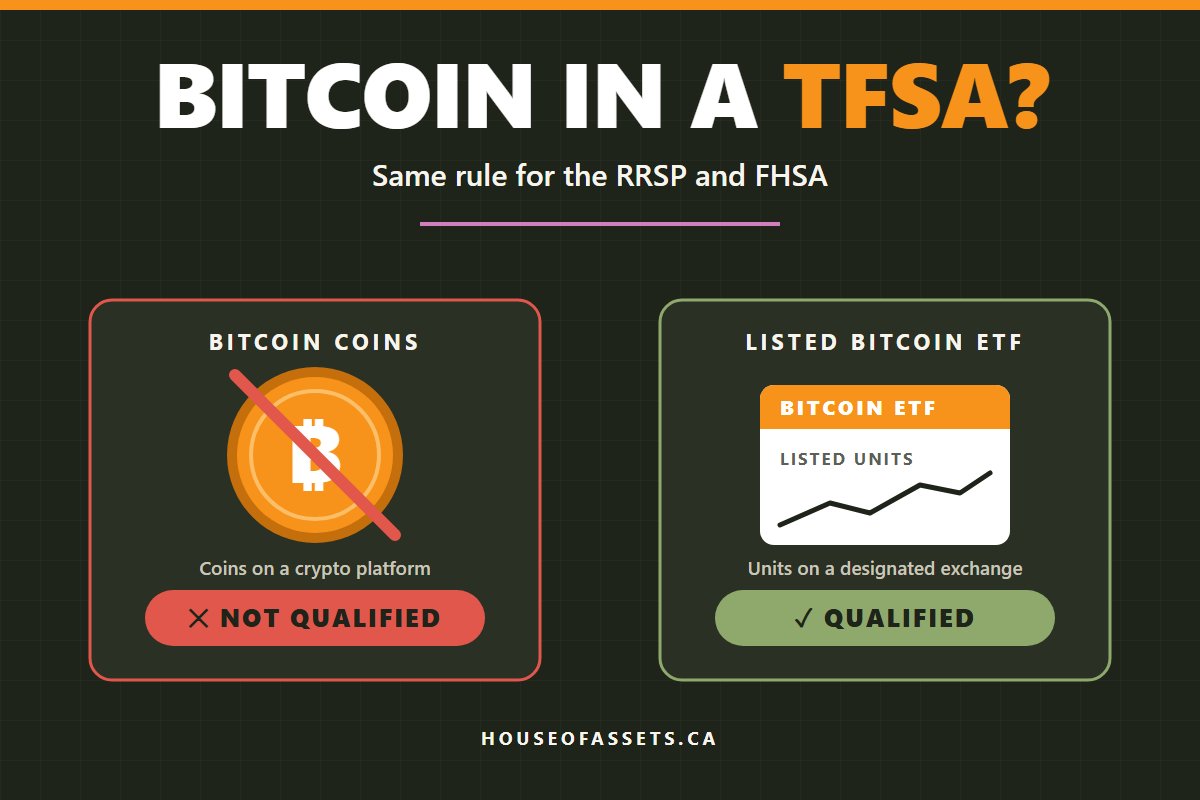
You cannot hold Bitcoin coins directly in a TFSA, RRSP or FHSA, because the Canada Revenue Agency (CRA) says cryptocurrencies are not qualified investments for registered plans. You can hold units of a Bitcoin exchange-traded fund (ETF) in those accounts, because securities listed on a designated stock exchange, including ETF units, are qualified investments.
This article explains where that line comes from, what happens if a registered account ends up holding something that does not qualify, and what to look at when comparing Bitcoin ETFs. It builds on 21 Bitcoin Basics and how Bitcoin is taxed in Canada.
Quick answer
| Question | Short answer (as of November 2026) |
|---|---|
| Can I put Bitcoin coins in my TFSA? | No. CRA says cryptocurrencies are not qualified investments. |
| Can I put Bitcoin coins in my RRSP or FHSA? | No. The same qualified investment rules apply to RRSPs, FHSAs, RRIFs, RESPs and RDSPs. |
| Can I hold a Bitcoin ETF in a TFSA, RRSP or FHSA? | Yes, if its units are listed on a designated stock exchange, such as the Toronto Stock Exchange or the Nasdaq. |
| Can I move Bitcoin from an exchange into my TFSA? | No. Only qualified investments can be contributed in kind, and Bitcoin is not one. |
| What if a TFSA holds a non-qualified investment? | A tax of 50% of its fair market value applies, plus tax on any income it earns. |
| Is a Bitcoin ETF gain in a TFSA taxed? | Generally no, unless the account is found to be carrying on a business. |
Why Bitcoin itself does not qualify
Registered plans can only hold "qualified investments", a list set out in the Income Tax Act. CRA's Income Tax Folio S3-F10-C1 lists the common types:
- Money, GICs and other deposits.
- Most securities listed on a designated stock exchange, such as shares, options, warrants, debt, and units of ETFs and real estate investment trusts.
- Mutual funds and segregated funds.
- Insured mortgages.
Money qualifies, but the folio is direct about crypto: cryptocurrencies such as Bitcoin are not considered money issued by a government, and they are not qualified investments. A coin sitting on a crypto trading platform is not a listed security either, so none of the categories above fit.
The same folio covers RRSPs, RESPs, RRIFs, RDSPs, FHSAs and TFSAs, so the answer is the same for every registered account.
Why a Bitcoin ETF does qualify
A Bitcoin ETF is a fund that holds Bitcoin (or, in some cases, Bitcoin futures contracts) and issues units that trade on a stock exchange like any other ETF. When those units are listed on a designated stock exchange, they are qualified investments under the folio's listed securities rule.
The Department of Finance keeps the list of designated stock exchanges. It includes the Toronto Stock Exchange and major US exchanges such as the Nasdaq and the New York Stock Exchange.
Canada was early here. The Toronto Stock Exchange listed the world's first Bitcoin ETF on 18 February 2021, a fund that holds physically settled Bitcoin. Several Canadian and US-listed Bitcoin ETFs now trade, and most Canadian brokerages offer them in registered accounts. CRA notes that firms can set their own, stricter limits on what their registered accounts hold, so a fund being a qualified investment does not mean every broker offers it in every account type.
What happens if a registered account holds a non-qualified investment
The consequences are steep. For a TFSA, CRA says:
| What happens | Detail |
|---|---|
| 50% tax | The holder owes a tax equal to 50% of the investment's fair market value when it was acquired or became non-qualified. |
| Special return | The tax is reported on Form RC243, TFSA Return. |
| Income is taxed | Any income earned on the non-qualified investment is taxable in the TFSA trust. |
| Possible refund | The 50% tax can be refunded if the investment is sold or stops being non-qualified before the end of the calendar year after the year it was taxed. |
RRSPs and RRIFs follow a similar rule: a 50% tax on the fair market value, reported on Form RC339 by 30 June of the following year.
How a Bitcoin ETF is taxed in each account
| Account | While you hold it | When you sell or withdraw |
|---|---|---|
| TFSA | Growth is generally not taxed | Withdrawals are generally tax-free, and the amount withdrawn is added back to your contribution room the next year |
| RRSP | Growth is not taxed while it stays in the plan | Withdrawals are taxed as income |
| FHSA | Growth is not taxed while it stays in the plan | A qualifying withdrawal to buy a first home is tax-free |
| Non-registered account | No tax until you sell | Selling is a capital gain or loss, half of which is taxable (as of November 2026) |
CRA also sets two limits. First, it says a registered plan that carries on a business, such as very frequent trading, can be taxed on that business income, so tax-free growth in a TFSA is not guaranteed for every trading pattern. Second, if you move ETF units from a regular account into a TFSA "in kind", CRA treats it as a sale at fair market value: a gain is taxable, but if the units are worth less than you paid, you cannot claim the capital loss.
For the FHSA's year-end contribution rules, see why 31 December matters for the FHSA.
What to compare between Bitcoin ETFs
This is not a list of picks. These are the facts each fund publishes, which make funds comparable:
- What it holds. Physically settled Bitcoin or Bitcoin futures contracts. Futures-based funds can track the price less closely over time.
- Fees. The management fee and the management expense ratio (MER), shown on the fund's facts document.
- Currency. Canadian dollar units, US dollar units, or a US-listed fund that trades in US dollars, where currency conversion costs apply.
- Custody. Who holds the Bitcoin for the fund, and where.
- Size and trading volume. Larger, more traded funds usually have narrower gaps between buying and selling prices.
An ETF also means you do not hold your own keys. Some people see that as a benefit, since there is no seed phrase to lose, and others prefer to hold coins themselves outside a registered account. The Bitcoin glossary explains keys, wallets and custody in plain terms.
FAQ
Can I transfer Bitcoin from Wealthsimple, Coinbase or another platform into my TFSA?
No. Only qualified investments can be contributed in kind, and Bitcoin is not one. Coins would have to be sold first, which is a taxable disposition in a regular account, and the cash could then be contributed if you have room.
Do Bitcoin ETFs count against my TFSA contribution room?
Yes. Money you contribute to buy any investment, including a Bitcoin ETF, uses contribution room. Growth inside the account does not.
Can I hold a US-listed Bitcoin ETF in my TFSA?
US exchanges such as the Nasdaq and the New York Stock Exchange are on Canada's list of designated stock exchanges, so units listed there are qualified investments. Whether your broker offers a given fund in a TFSA is up to the broker.
Is the loss on a Bitcoin ETF in a TFSA deductible?
No. Gains in a TFSA are not taxed, and losses inside it cannot be used to reduce tax elsewhere.
Sources
- CRA: Income Tax Folio S3-F10-C1, Qualified Investments
- CRA: Before you contribute to a TFSA
- CRA: If you owe tax on non-permitted TFSA investments
- CRA: Tax payable on non-qualified investments on RRSPs and RRIFs
- CRA: Form RC243, Tax-Free Savings Account (TFSA) Return
- Department of Finance Canada: Designated Stock Exchanges
- TMX Group: Toronto Stock Exchange lists world's first Bitcoin ETF (18 February 2021)
Last updated: 7 November 2026.