How Bitcoin Is Taxed in Canada: Capital Gains vs Business Income
Last updated:
This article is general information, not financial advice. Rates, limits and offers change, so confirm current details with the source or a licensed professional. Read the full disclaimer.
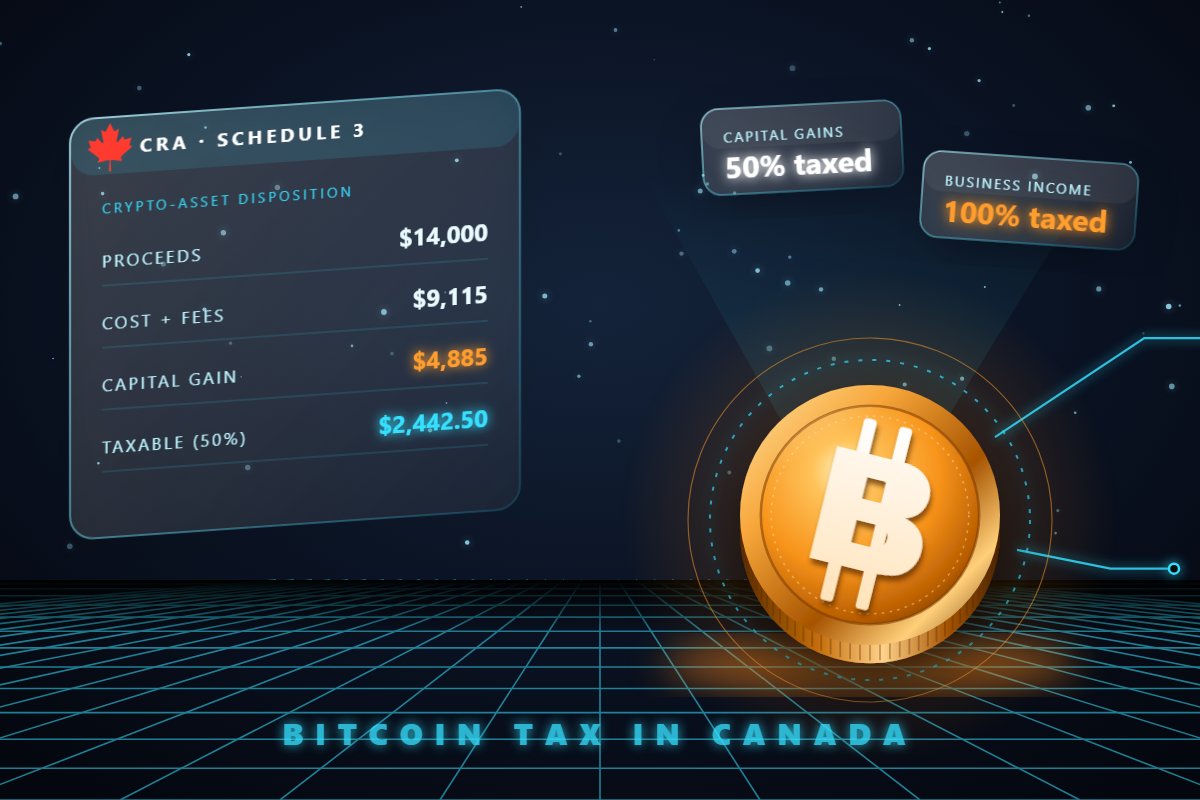
In Canada, Bitcoin is taxed when you dispose of it, which includes selling it for dollars, trading it for another crypto, spending it or giving it away. For most people who buy and hold, the profit is a capital gain and half of it is added to taxable income (the 50% inclusion rate, as of November 2026), while frequent, business-like trading is taxed as business income, where the full profit is taxable.
Buying Bitcoin and holding it is not a taxable event, and neither is moving it between wallets you own. This guide walks through what the Canada Revenue Agency (CRA) counts as a disposition, how the two kinds of income differ, a few worked examples in Canadian dollars, and the records CRA expects you to keep. If any of the words are new, our Bitcoin terms glossary explains them, and 21 Bitcoin Basics covers the fundamentals.
Quick answer
| Question | Short answer (as of November 2026) |
|---|---|
| Is buying Bitcoin taxable? | No. Tax applies when you dispose of it. |
| Is selling Bitcoin for Canadian dollars taxable? | Yes, it is a disposition. |
| Is trading Bitcoin for another crypto taxable? | Yes. CRA treats a crypto-to-crypto trade as a disposition. |
| Is paying for something with Bitcoin taxable? | Yes. CRA treats it as a barter transaction and a disposition. |
| Is moving Bitcoin between my own wallets taxable? | No. CRA says transfers between wallets you own are not a taxable disposition. |
| How much of a capital gain is taxed? | Half (the 50% inclusion rate). |
| How much business income is taxed? | All of the net profit. |
| How long should I keep records? | At least six years from the end of the tax year they relate to. |
What counts as a taxable disposition of Bitcoin?
CRA says a disposition of a crypto-asset may happen when you:
- Sell or exchange it for government-issued money, such as Canadian or US dollars.
- Trade it for another crypto-asset (for example, Bitcoin for Ether).
- Use it to buy goods or services.
- Give it away as a gift or donation.
CRA notes the list is not complete, so other events can also count. Because Bitcoin is not government-issued currency, paying with it is treated as a barter transaction for tax purposes: you are treated as having disposed of the Bitcoin at its value at that moment.
Capital gain or business income: which one applies?
When you dispose of Bitcoin, the result is either a capital gain (or loss) or business income (or loss). CRA decides case by case, looking at how you behave, not just what you call yourself.
CRA lists these signs that you may be carrying on a business:
- Frequency: a history of buying and selling crypto a lot.
- Holding period: owning coins for short periods and turning them over quickly.
- Knowledge: knowledge of, or experience in, crypto markets.
- Time spent: spending a substantial part of your time studying crypto markets.
- Financing: buying crypto with borrowed money.
- Advertising: advertising that you are willing to buy crypto.
Even a single transaction can be business income if CRA sees it as an "adventure or concern in the nature of trade", meaning a one-off deal made to turn a profit. If none of this describes you and you bought Bitcoin to hold over time, your gains and losses are generally on capital account.
| Capital gain (or loss) | Business income (or loss) | |
|---|---|---|
| Typical situation | Buying and holding for the long term | Frequent, business-like trading or mining |
| How much is taxable | Half of the gain (50% inclusion rate) | The full net profit |
| Losses | Half of a capital loss can only reduce taxable capital gains | Business losses can reduce other income |
| Unused losses | Net capital losses can be carried back three years or forward indefinitely | Follows the business loss rules |
| Where it is reported | Schedule 3 and line 12700 of your return | Form T2125 and the business income lines of your return |
| CRA guide | T4037, Capital Gains | T4002, Self-employed Business Income |
How capital gains on Bitcoin are calculated
A capital gain is the proceeds of disposition minus your adjusted cost base (ACB) and any costs of selling. The ACB is usually what you paid for the Bitcoin plus the fees to buy it. If you bought Bitcoin at several different prices, the ACB is the average cost of all the units you hold, so each sale uses that average.
Half of the gain is the taxable capital gain, which is added to your income and taxed at your marginal rate. Half of a capital loss is an allowable capital loss, which can only be used against taxable capital gains, not against employment or other income.
Worked example 1: selling Bitcoin for Canadian dollars
The figures below are made up to show the method.
| Step | Amount |
|---|---|
| Bought 0.1 BTC for $9,000 plus a $45 trading fee | ACB = $9,045 |
| Later sold the 0.1 BTC for $14,000 and paid a $70 fee | Proceeds = $14,000 |
| Capital gain: $14,000 minus $9,045 minus $70 | $4,885 |
| Taxable capital gain (50%) | $2,442.50 |
The $2,442.50 is added to your income for the year you sold. The tax you pay on it depends on your total income and your province.
Worked example 2: trading Bitcoin for another crypto
Swapping one crypto for another is treated like selling the first one at its fair market value in Canadian dollars at the time of the trade. CRA gives this example on its crypto guide:
| Step | Amount |
|---|---|
| Value of the crypto given up on the day of the trade | $20,600 |
| What you originally paid for it (ACB) | $15,000 |
| Capital gain | $5,600 |
| Taxable capital gain (50%) | $2,800 |
If the crypto you gave up had cost $25,000 instead, the result would be a $4,400 capital loss, of which $2,200 is an allowable capital loss. The new coin you received starts with an ACB equal to its value on the day of the trade ($20,600 here).
Worked example 3: paying for something with Bitcoin
Say you pay for a $500 item with Bitcoin that cost you $300. You have disposed of Bitcoin worth $500, so there is a $200 capital gain and $100 is taxable. Small purchases add up, which is one reason CRA asks for a record of every transaction.
How business income from Bitcoin is taxed
If your crypto activity is a business, the full net profit is taxable, not half. CRA's own example shows a trader who sold $240,000 of crypto in 2025, with $180,000 of opening inventory, $30,000 of purchases, $12,000 of closing inventory and $2,000 of expenses. The cost of goods sold works out to $198,000, and the net business income is $40,000, all of which goes on the return.
Business income is reported using Form T2125 and Guide T4002. Business losses can reduce other income, which is a key difference from capital losses.
Mining and staking rewards
CRA says that in most cases Bitcoin mining is a business because of the scale and resources involved, so the value of the coins you receive is business income when you earn it. Mining equipment such as ASIC miners and GPU rigs can generally qualify for capital cost allowance (CCA) in class 50.
Bitcoin itself is not staked, but if you hold other crypto and earn staking rewards on a centralized exchange, CRA generally treats those rewards as income when they are credited to your account.
What about Bitcoin ETFs in a TFSA or RRSP?
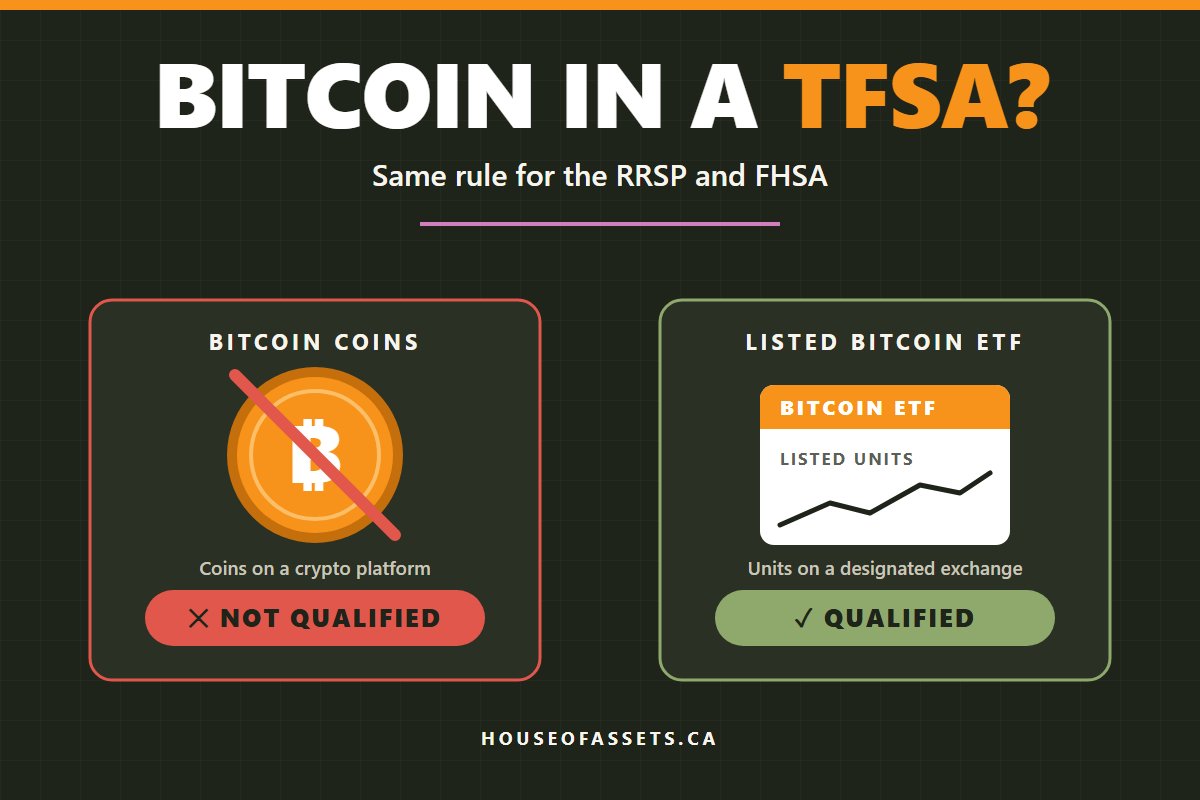
You cannot hold Bitcoin coins directly in a TFSA or RRSP, but Bitcoin exchange-traded funds (ETFs) listed on Canadian exchanges can be held in these accounts at most brokers. Growth and withdrawals inside a TFSA are generally not taxed, and growth inside an RRSP is taxed only when you withdraw. In a regular (non-registered) account, selling a Bitcoin ETF is treated like selling any other ETF, with capital gains rules applying. Check with your broker which funds it offers in each account type.
Records CRA expects you to keep
CRA asks crypto users to keep records of every transaction, including:
- The number of units and type of crypto-asset.
- The date and time of each transaction.
- The value in Canadian dollars at the time of each transaction.
- What the transaction was and who the other party was (even if it is only a wallet address).
- The addresses of each wallet you use.
- The starting and ending balance (and its cost) of each crypto-asset for each year.
If you use an exchange, CRA suggests exporting your trade and transfer history regularly, in case the exchange shuts down, leaves Canada or you lose access. Keep records for at least six years from the end of the last tax year they relate to.
How to report Bitcoin on your tax return
- List every disposition in the year (sales, swaps, purchases paid in crypto and gifts).
- Work out the Canadian dollar value and the ACB for each one.
- Decide whether your activity is on capital account or a business, using CRA's factors above.
- For capital gains or losses, complete Schedule 3 and report the taxable amount on line 12700.
- For business income, complete Form T2125.
- Keep your records and exchange exports with your tax file.
Tax software and a tax professional can help if you have many transactions. For a lighter take on the taxman, see I Am the Tax Man.
FAQ
Do I pay tax on Bitcoin if I don't sell it?
Generally no. Holding Bitcoin, even if its price rises, is not taxable on its own. Tax applies when you dispose of it, which includes selling, swapping, spending or giving it away.
Is the capital gains inclusion rate still 50% in Canada?
Yes, as of November 2026. A proposed increase to two-thirds was announced in 2024, deferred in January 2025 and cancelled by the Government of Canada on 21 March 2025. CRA administers the one-half rate.
Can I use a Bitcoin loss to lower my tax?
A capital loss on Bitcoin can reduce taxable capital gains in the same year. Any unused net capital loss can be carried back three years or carried forward indefinitely, but only against capital gains. It cannot reduce employment income.
Is moving Bitcoin from an exchange to my own wallet taxable?
No. CRA says transferring crypto between wallets you own is not a taxable disposition. Keep a record of the transfer so you can show the coins are still yours.
Does CRA know about my Bitcoin?
Everyone who disposes of crypto is required to report it, whether or not an exchange sends CRA any information. Keeping full records protects you if CRA asks questions later.
Sources
- CRA: Reporting income from crypto-asset transactions
- CRA: Information for crypto-asset users and tax professionals
- CRA: Understanding crypto-assets and your tax obligations
- CRA: Keeping books and records of crypto-assets
- CRA: Reporting income from crypto-asset mining and staking
- CRA: Guide T4037, Capital Gains
- CRA: Guide T4002, Self-employed Business Income
- CRA: Update on the capital gains inclusion rate (January 2025)
- Prime Minister of Canada: proposed capital gains tax increase cancelled (21 March 2025)
Last updated: 4 November 2026.